Blog
From Data to Decisions: Rethinking Workplace Intelligence
Productivity is an organisation-wide challenge, yet many businesses are still tackling it through disconnected technology and isolated smart space investments. This article explores why a piecemeal approach to IoT can create more data without delivering better outcomes, and how Workplace Intelligence offers a more joined-up alternative—starting with people and desired outcomes, then connecting the data, technology and insights needed to make smarter decisions and create a more productive workplace.

Productivity touches every part of the organisation; it can’t be treated in isolation.
In the modern workplace, there are few concepts that take centre stage as often as productivity. Beyond just a measurement of work that can be produced in a given time frame, for leaders and decision makers productivity is one of the key indicators of overall organisational health. The satisfaction of the workforce, the design of the workplace, the efficiency of its systems – in reality, productivity is an umbrella term that encompasses all of these elements, and more. So, when a major review of workplace productivity estimates a potential £71.4 billion is being lost each year in “unrealised GDP” – or more directly, a £25.2 billion annual cost to employers paying for “unproductive” time in FTE salaries – what we’re seeing is that productivity, the very thing meant to define organisational health, is quietly failing across the UK.
Over the past two decades, we’ve seen the Internet of Things (IoT) and smart spaces transition from niche curiosities to mainstream adoption – in large part thanks to organisations attempting to grapple with productivity. As the technology has matured, so too has its potential to reduce costs, eliminate inefficiencies, and improve the workplace, to the point where it is now the number one investment priority for UK Facilities Management decision makers in 2026. At the same time, however, research continues to be released showing that many organisations are still not seeing the full potential of the technology reflected in their investments. A recent pair of reports by TalkTalk Business illustrates this dichotomy: while nearly three-quarters of public sector organisations have adopted at least one type of IoT or smart spaces technology, only 34% of UK IT professionals felt their network was “truly ready to implement the concept”. In other words, two thirds of UK organisations don’t feel ready to fully deploy the technology, despite a large number of them having already invested in doing so.
A piecemeal approach to an interconnected problem
Of course, even if problem areas are easily identifiable, their solutions are rarely as simple to implement; the introduction of any new system or process can have wide-ranging and unforeseen effects throughout an organisation. Despite this, IoT and smart spaces technologies continue to be sold in a manner more familiar to those buying technology ten or fifteen years ago – as isolated, off-the-shelf units focused around solving specific problems. Such products rarely achieve the outcomes for which they were intended, and can quickly become siloed and complicated as additional factors get added in. A modern organisation would no longer make network investments in this way, so why is it still common when it comes to smart spaces and IoT?
Counterintuitively, a major part of the problem is due to the ease with which organisations can now invest in smart technology. With the maturation of the technology, individual sensors have become accessible, affordable, and available to target a wide variety of data types. As a result, if an organisation has identified a problem and requires data to solve it, they can easily find a sensor that provides exactly what they need without it having to integrate into any other part of the network. Given the low cost of entry, minimal perceived risk, and often no need for IT integration, the purchase of smart technology is often viewed as a simple transaction that doesn’t require more careful consideration or a broader strategy.
However, collecting this data is not the same as putting it to work. Once these sensors are actively accumulating data, what has meaningfully changed? Does that data enable new decisions? How is it accessed? How is it compared against existing data, or shared with other teams, or placed in a broader context? If the organisation is still not achieving its desired outcomes, could another investment provide the solution? Proceeding in this piecemeal fashion, organisations can progressively cobble together a patchwork of sensors and platforms, not realising that they are compounding the problem until they’ve already invested a substantial amount. They find themselves burdened with disparate systems that don’t communicate, data that gathers dust in isolated silos, and reporting that is separated by vendor and inaccessible to teams that need it. Organisations are deeply complicated, interconnected structures; a successful investment in smart spaces needs to reflect this in its own approach, viewing each element as part of a wider whole, and each data point influencing and being influenced by the others.
How is Workplace Intelligence different?
Before thinking about the data that is or isn’t being collected, Workplace Intelligence focuses on why that data is needed. Starting from an understanding of your desired outcomes, we work to develop a complete picture of your organisation as it exists today, and as you would like it to exist in the future.
To do this, we continuously refer back to your people – how they use the building, where they encounter friction, and what they need to be able to do. We’re not setting out to create a smart building, but to create a building that enables smart decisions for the people who use it.
Once we have this full understanding of your organisation, the decisions you want to make, and why, we can begin to look at the data needed in order to facilitate those decisions, and where that data can come from. The goal is never just to collect and surface data, but to give it the context and purpose needed to be useful.
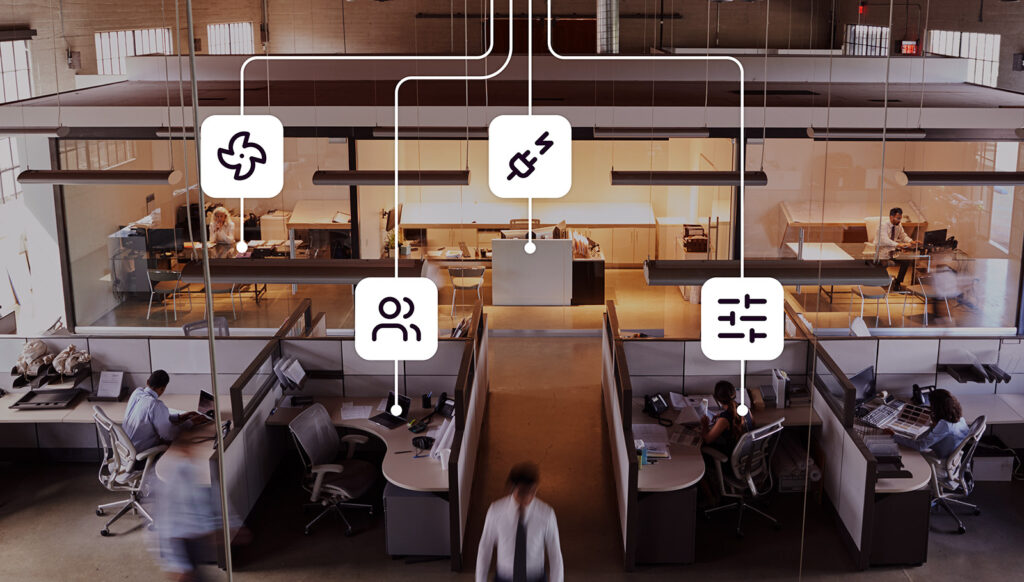
The result is a central platform that gathers, analyses, and presents digestable data from across the entirety of your organisation – including occupancy, indoor air quality, energy consumption, and resource management – wrapped in a service offering that ensures that you fully understand the data you have access to, the potential decisions it enables, and the capacity to act on those decisions to achieve your outcomes.
Find out more about Workplace Intelligence on our dedicated page, or get in contact to start the conversation for yourself.
About the author



Related