Blog
What is the minimum your business needs to keep running?
Resilience planning often starts with technology, yet the more important question is which parts of the business must keep running during an outage or cyberattack. A minimum viable business sorts activities into three groups: those that must continue, those that can run in a degraded form, and those that can pause. Using these groups gives business continuity, disaster recovery and security planning a shared starting point. This blog explores how to turn that exercise into technical requirements, from cyber resilience and infrastructure maintainability to provider dependencies and the cost of failure. It closes with five questions to ask before the next breach.


Jump to:
- Business resilience starts with the business, not the technology
- What a minimum viable business means for operational resilience
- An example from health: separating critical services from everything else
- Cyber resilience is about continuing to operate, not only preventing incidents
- Business continuity depends on how infrastructure is run
Business resilience starts with the business, not the technology
Resilience planning often begins with technology. Teams look at redundant infrastructure, backup power, network connections and recovery. These measures remain necessary, but they do not answer a more basic question: which parts of the business must keep running when technology fails due to an outage or when under attack.
That question belongs to the business as well as to IT. Can your leadership team say what your minimum viable business is?
No organisation can protect every system equally or prevent every disruption. Budgets, skills and time are limited, so priorities have to be set. Without a clear view of what the business cannot do without, those priorities tend to follow technical severity or habit rather than business impact.
A minimum viable business is the set of functions that must continue during disruption, rather than every activity the organisation normally performs. Defining it gives business continuity, disaster recovery and security planning a shared starting point.
What a minimum viable business means for operational resilience
The term minimum viable business is a practical framing rather than a new discipline. It overlaps with established business continuity practice and works best when it is kept simple. It asks leaders to sort their activities into three groups:
- Must continue: services that cannot stop without serious consequences for customers, safety, revenue or legal obligations.
- Can run in a degraded form: services that can operate with reduced capacity, manual workarounds or slower response for a defined period.
- Can pause: activities that can stop for hours or days without lasting harm.
Using this framework is not a permanent operating model. Instead, it is a prioritisation tool for emergencies. Once the above groups are agreed, further questions follow:
- How long can each service be interrupted?
- What level of degradation is acceptable?
- Which systems, people and providers does it depend on?
The answers to these questions turn business priorities into technical requirements for operational resilience, such as where redundancy is needed, which systems need tested recovery and which deserve the closest monitoring.
An example from health: separating critical services from everything else
Healthcare makes the three-group idea easy to see. A hospital has to keep caring for patients, provide medication, carry out operations and look after people in intensive care and onwards. These services cannot simply wait while an IT system is restored and in the meantime, depend on emergency procedures.
Other activities, such as some administrative processes and some operations, can often be postponed for longer without immediate harm.
The split will differ from one hospital to the next, and this example is illustrative. The value lies in the exercise itself: deciding in advance which services must continue immediately and which can safely wait.
The same exercise applies wherever services cannot tolerate prolonged interruption, including critical infrastructure, manufacturing and logistics. The details change, but the logic does not. Decide what must continue, then decide how to protect it.
Cyber resilience is about continuing to operate, not only preventing incidents
Security and resilience are complementary. Security reduces the likelihood and scope of a compromise. Cyber resilience determines whether essential services can continue and recover when prevention is not enough. An organisation can reasonably want to become more secure and, at the same time, want to be sure it can keep operating if something goes wrong. This matters because it is difficult to prevent every failure, or to patch every weakness before it is exploited. Linking investment to the scenarios that threaten essential operations, rather than only to technical severity, helps organisations focus on what makes the most difference.
Defining a minimum viable business also gives cyber incident response plans a clearer purpose. A response plan is more useful when it states which services are protected first, who has the authority to decide, and what a workable level of service looks like while recovery is under way.
Business continuity depends on how infrastructure is run
Resilience is something an organisation runs, not something it builds once. Redundant connections and backup power help, but in environments that need connectivity at all times, such as factories, warehouses and hospitals, the infrastructure must also be maintained, updated and secured while the operations that depend on it carry on.
This creates a real dilemma. Security teams ask for faster patching, yet operational teams may have few opportunities to take systems offline. One practical response is to treat maintainability as a resilience requirement. Infrastructure should be observable, recoverable and, where possible, capable of being updated with minimal interruption. In some cases that depends on choosing suitable hardware, licensing and management tooling.
Where infrastructure cannot yet be updated with minimal interruption, that limitation should be recorded as a risk to be managed rather than treated as an inconvenience to be worked around.
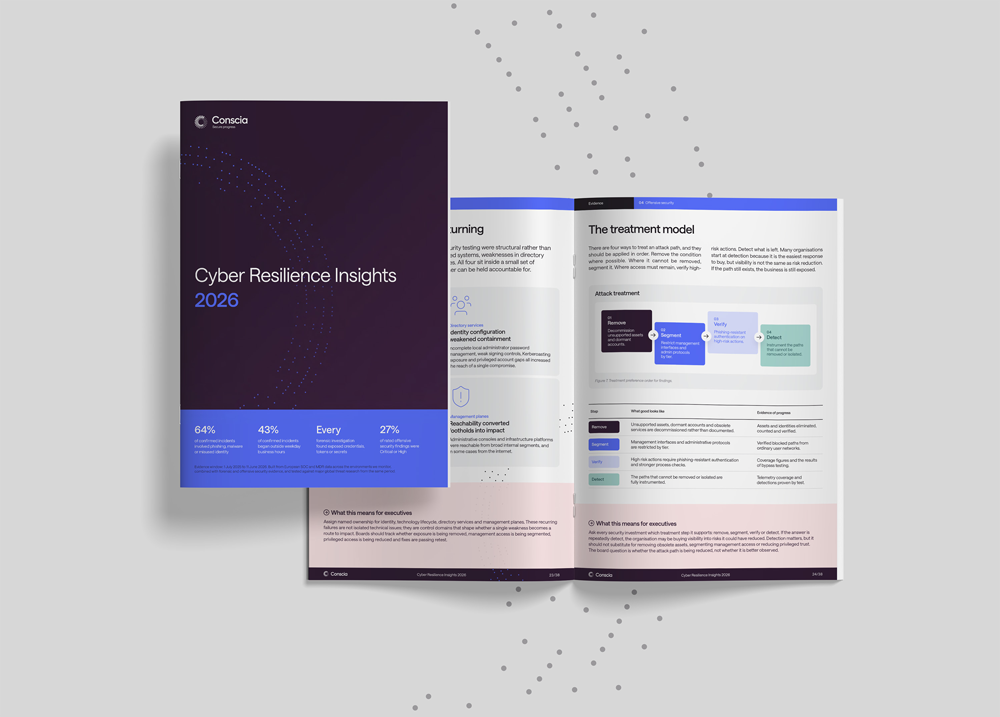
Report: Cyber Resilience Insights 2026
Move beyond headline threat trends. Cyber Resilience Insights 2026 connects our own European SOC and MDR data, forensic investigation, offensive security testing and global threat research to show whi…
Critical services and providers: where business continuity can fail
A critical service rarely depends on a single system. It relies on cloud platforms, software applications, identity services, integrations, data and specialist skills, many of which sit with external providers. Mapping the dependencies behind each critical service shows where continuity could break.
It also turns provider contingency into a practical question. Could the service continue if a main provider or site became unavailable? Which workloads could move, where could they go, what data would need to follow, and for how long could the service be maintained in the meantime? A backup plan is more credible when it is technically feasible and has been tested, not only written into a contract.
Proportionality matters. Not every workload needs immediate portability, but the services in the “must continue” group deserve a contingency that has been exercised.
Disaster recovery priorities: weigh the cost of failure, not only the cost of protection
Cost enters almost every technology decision, and resilience is no exception. A useful counterweight is to compare what protection and recoverability cost with what failure could cost: lost operations, safety consequences, regulatory exposure and customer impact. Priorities often change once an organisation recognises that losing a key network or system could stop it from operating at all.
It is better to work through that comparison before an incident than during one. The figures will be specific to each organisation, so they are best built from its own services and dependencies rather than from generic averages.
Five questions to ask before the next disruption
A short set of questions can turn the minimum viable business from an idea into a working exercise:
- What must keep running?
- How long can it stop or operate in a degraded form?
- Which systems, people and providers does it depend on?
- Could it continue if the main provider or site became unavailable?
- When was that assumption last tested?
Answering these questions is where business priorities become technical requirements. The exercise does not replace business continuity, disaster recovery or security programmes. It gives them a shared purpose and a clearer order of work. The answers should be revisited as services, suppliers and threats change.
About the author




Related