Blog
From policy to purchase order: sovereignty reshapes cybersecurity buying
As European organisations rethink where their security tools come from, digital sovereignty is shifting from a policy debate into a practical procurement question. This article explores what that shift means for security teams, from weighing supplier dependencies and contractual safeguards to planning exits, and why reducing risk should never come at the expense of strong defences.


Jump to:
- What the numbers actually show
- Sovereignty is becoming a security control
- What security teams should prioritise
European organisations are directing more cybersecurity spending toward suppliers headquartered in the EU. The Register reported the shift on 12 November, using figures released by market intelligence firm CONTEXT the previous day. The data indicates that sovereignty is moving from a policy discussion into practical technology selection.
CONTEXT found that sales of EU-headquartered cybersecurity products through tracked EMEA distributors increased 35% between Q3 2024 and Q3 2026. Overall cybersecurity sales through those distributors grew 10%, while sales from US-headquartered suppliers rose 8%. EU vendors gained nearly three percentage points of market share, reaching 15% by value, although US vendors still held 62%.
The primary data supports a meaningful shift, but not a wholesale departure from American technology. It also covers distributor sales across Europe, the Middle East and Africa, rather than the entire EU technology market. Direct contracts, hyperscaler marketplaces and some software-as-a-service purchases may not appear in the figures.
What the numbers actually show
European suppliers are strongest in categories where buyers can change providers without replacing the foundations of their infrastructure. EU-headquartered vendors represented 92% of tracked security awareness training sales, 82% of vulnerability management and 52% of SIEM and log management. US vendors retained 74% of identity and access management sales and 54% of cloud security.
This suggests that organisations are pursuing selective sovereignty rather than complete replacement. A company can retain an established identity or cloud platform while moving security logs, vulnerability data or employee training to a European provider. Such changes reduce specific dependencies without forcing an expensive, high-risk transformation of the entire technology stack.
The figures do not confirm why sales increased. They do not isolate the effect of Trump administration policies from regulation, product quality, pricing or normal renewal cycles. CONTEXT also did not break the increase into new customers, acquisitions, price changes or shifts in product mix. Vendor headquarters therefore explain how the data was categorised, not necessarily why each buyer selected a product.
Sovereignty is becoming a security control
A CPR number is intended to be persistent, but it can be changed in limited circumstances, including legal gender recognition and documented identity misuse. That does not make replacement a practical response at population scale. Once name, address and number are paired for most of a population, they become a durable resource for fraud and social engineering. The ministry’s own warning – that callers who know your name, address and CPR number should still not receive confidential information – shows where the concern lies.
Any organisation that accepts these three data points as proof of identity now has a weaker control. Helpdesk resets, call-centre verification and account recovery flows deserve immediate review. Records of deceased and emigrated persons may also be less likely to be noticed or contested by the individuals concerned. That is a reasonable concern for fraud teams, though not something the sources confirm.
This is not the first time Danish CPR numbers have been exposed. Earlier incidents included a supplier-operated tax portal that leaked around 1.26 million numbers to analytics providers over several years. The mechanisms differ, but the pattern holds: every exposure of a persistent identifier adds to what attackers can correlate.
Conscia ThreatInsights
The only threat intelligence newsletter that focuses primarily on Europe According to Forrester, European organisations face several different cybersecurity threats compared to their global counterpar…
What security teams should prioritise
Begin with a dependency map rather than a list of vendor nationalities. For each important security service, record the data it receives, processing locations, key custody, privileged support access, subcontractors, software update path and reliance on another cloud or identity provider. Include beneficial ownership and operational control, because an EU headquarters does not guarantee an entirely European service chain.
Procurement requirements should be tied to workload criticality. A security awareness platform does not require the same continuity arrangements as identity, endpoint detection or a SIEM holding sensitive incident data. Define which services require EU-based processing, customer-controlled keys, locally cleared support personnel or an operational alternative. Document why each requirement is proportionate to the risk.
Contracts should cover data location, administrative access, subprocessors, incident notification, audit rights, evidence retention and secure deletion. Require usable export formats for logs, detection rules, configurations and case records. For critical services, specify termination assistance and time limits for returning data. These provisions matter more during a crisis than a general sovereignty label.
Test the exit plan before it is needed. Security teams should verify that they can export configurations, move keys, redirect telemetry and preserve investigations without the supplier’s normal control plane. Tabletop exercises should include loss of regional service, a change in ownership, legal restrictions on support, and the sudden unavailability of a strategic provider.
Organisations should also avoid weakening their defences merely to meet a geographic preference. Replacing a mature security control with a less capable product can increase exposure even if it reduces jurisdictional risk. A staged approach, beginning with portable services and supported by parallel operation or fallback arrangements, is safer than a flag-driven migration.
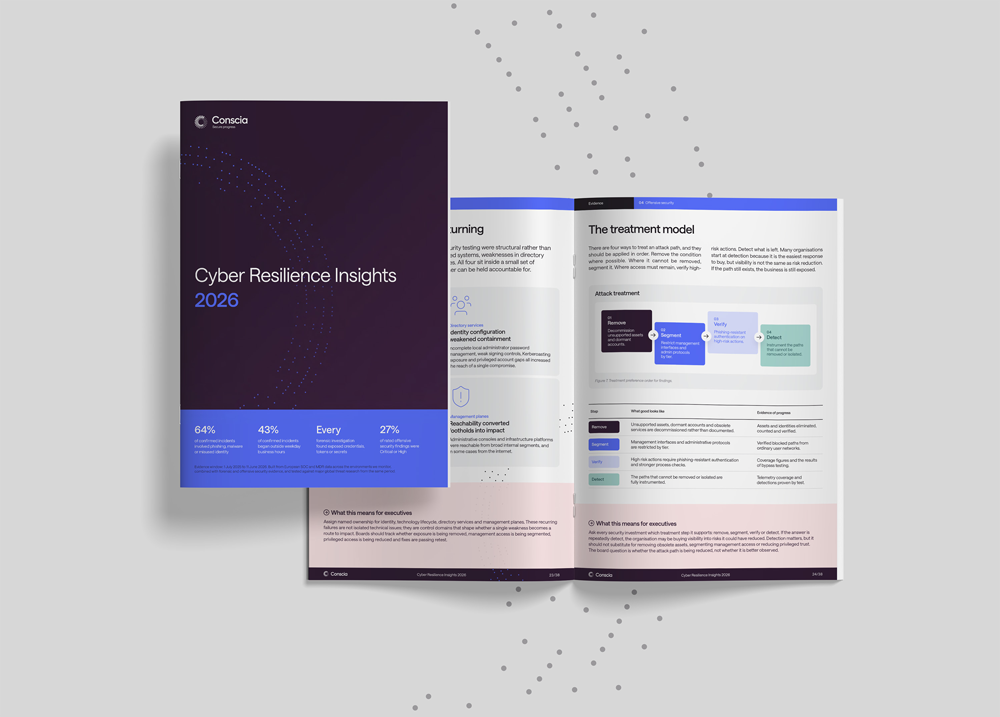
Report: Cyber Resilience Insights 2026
Move beyond headline threat trends. Cyber Resilience Insights 2026 connects our own European SOC and MDR data, forensic investigation, offensive security testing and global threat research to show whi…
About the author

David Kasabji
Head of Threat Intelligence, Conscia Cyber & AI Security
David Kasabji is the Head of Threat Intelligence at the Conscia Group. He leads the development and delivery of actionable intelligence across cyber defense and managed security operations, translating complex threat activity into clear outcomes for different audiences — from SOC analysts and incident responders to executive stakeholders and external communications.
His work spans end-to-end intelligence operations: collection and analysis of adversary activity, threat actor and campaign profiling, IOC and TTP development, and intelligence-driven guidance for detection, threat hunting, and security prioritization. David is also actively involved in Digital Forensics and Incident Response, supporting investigations and crisis situations with rapid triage, context, and strategic recommendations. A strong focus of his role is continuously improving how intelligence is operationalized through standardization and automation to ensure it is timely, relevant, and measurable.nd strategic crisis management during incidents.



Related